

Krashen vs Chomsky: How Their Theories Shape TEFL in 2026
20th December 2025
If you’ve ever wondered why some learners speak fluently but struggle with grammar or why others know every rule yet hesitate to speak, you’re already touching the heart of the Krashen vs Chomsky debate. These two linguistic giants shaped how we understand language learning, and decades later, their ideas continue to influence how English is taught worldwide.
In 2026, TEFL classrooms look very different AI tools, immersive platforms, and global online learners, but the core question remains the same: Do learners acquire language naturally, or do they need structured instruction first?
Understanding this debate helps modern TEFL educators design smarter lessons, reduce learner anxiety, and balance communication with accuracy, an approach strongly emphasized in programs like an International P G Diploma in TEFL.
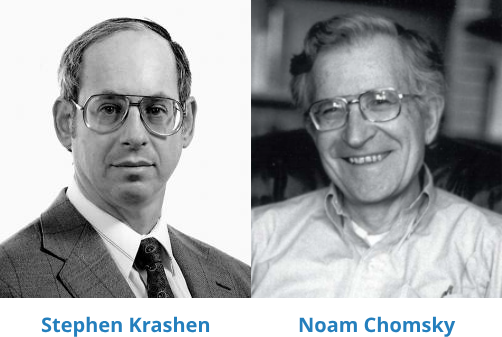
Who Is Noam Chomsky?
Noam Chomsky revolutionized linguistics by proposing that humans are biologically wired to learn language. His theory of Universal Grammar suggests that all humans are born with an innate language faculty that helps them understand grammatical structures.
Key Ideas from Chomsky
- Language learning is driven by innate cognitive structures
- Grammar plays a central role in language development
- Exposure activates internal language mechanisms
- Errors are part of rule-testing, not failure
How This Influences TEFL
In TEFL classrooms, Chomsky’s ideas show up when:
- Teachers explicitly teach grammar rules
- Lessons focus on sentence structure and syntax
- Accuracy is emphasized alongside fluency
- Learners analyze language patterns consciously
This approach works particularly well for analytical learners and advanced students who want precision.
Who Is Stephen Krashen?
Stephen Krashen took a very different route. He argued that language is best acquired naturally, not learned through memorization or drills. His theories are especially popular in communicative and learner-centered classrooms.
Krashen’s Core Hypotheses
- Acquisition vs Learning: Real fluency comes from acquisition, not rule study
- Comprehensible Input: Learners progress when input is just slightly above their current level
- Affective Filter: Anxiety blocks learning; low stress accelerates it
- Silent Period: Learners don’t need to speak immediately to learn
How This Influences TEFL
Krashen’s ideas dominate modern ESL practices:
- Task-based learning
- Storytelling and role-play
- Immersion-style lessons
- Error tolerance during early stages
In 2026, these principles align perfectly with online, blended, and immersive TEFL environments.
Krashen vs Chomsky: Key Differences at a Glance
|
Aspect |
Chomsky |
Krashen |
|
Focus |
Grammar & structure |
Meaning & communication |
|
Learning Style |
Cognitive, analytical |
Natural, experiential |
|
Role of Errors |
Evidence of rule testing |
Natural and acceptable |
|
Teaching Style |
Explicit instruction |
Implicit exposure |
|
Classroom Tone |
Structured |
Low-anxiety, fluid |
What Does TEFL Look Like in 2026?
TEFL in 2026 no longer follows a single teaching philosophy. Instead, it reflects a balanced integration of Krashen’s natural acquisition principles and Chomsky’s structural insights. Today’s TEFL classrooms, both online and offline, are learner-centred, tech-enabled, and globally diverse.
Modern TEFL environments emphasize:
- Communication-first learning, where students use English meaningfully before focusing on accuracy
- Strategic grammar instruction, introduced after learner’s encounter language in real contexts
- Digital immersion, including AI tools, adaptive platforms, and multimedia input that mirrors real-life exposure
- Flexible pacing, allowing learners to acquire language at their own rhythm
Rather than drilling rules or relying only on conversation, TEFL in 2026 creates purposeful interaction supported by structure, ensuring learners gain both fluency and confidence.
How Teachers Can Apply These Theories Practically
Understanding theory only matters when it improves classroom practice. In 2026, effective TEFL teachers translate Krashen’s and Chomsky’s ideas into intentional teaching strategies.
Here’s how this looks in action:
- Begin with meaningful tasks such as discussions, role-plays, or storytelling before introducing grammar explanations
- Lower the affective filter by creating safe, inclusive spaces where mistakes are treated as part of learning
- Use grammar as a support tool, not the lesson’s focal point, short explanations after communication work best
- Encourage exposure over memorisation, using videos, podcasts, and interactive reading rather than isolated drills
- Offer reflective feedback, helping learners notice patterns instead of correcting every error in real time
This practical blend allows teachers to respond to diverse learner needs while keeping lessons dynamic and relevant.
Why Understanding This Debate Makes You a Better TEFL Teacher
Teachers who understand why language learning works are far more effective than those who only follow lesson templates. Knowing the Krashen–Chomsky debate equips TEFL educators with teaching clarity, adaptability, and confidence.
This understanding helps teachers:
- Make informed decisions about lesson structure
- Adjust methods for anxious, analytical, or mixed-ability learners
- Avoid overcorrecting or under-teaching grammar
- Design lessons that are both engaging and academically sound
- Teach across cultures with sensitivity and awareness
Ultimately, this knowledge transforms teachers from lesson deliverers into language facilitators, professionals who understand how learners truly acquire language and how to guide them effectively in modern TEFL classrooms.
Final Thoughts
The Krashen vs Chomsky debate isn’t about choosing a winner, it’s about understanding learners better. In 2026, successful TEFL educators combine natural acquisition with structured support, communication with clarity, and empathy with expertise.
If you want to teach confidently in global classrooms, online or offline, mastering this balance is essential, and it’s a core focus of advanced training pathways like a 400-hour International TEFL Course, where theory and real-world practice finally meet.
Frequently Asked Questions (FAQs)
1. Why is the Krashen vs Chomsky debate still relevant in TEFL?
Their theories explain two core aspects of language learning, natural acquisition and structured grammar, both essential in modern TEFL classrooms.
2. Which theory is better for TEFL teaching?
Neither works alone. Effective TEFL in 2026 blends Krashen’s communicative approach with Chomsky’s focus on structure and accuracy.
3. How does Krashen influence modern TEFL?
Krashen’s ideas support low-anxiety classrooms, meaningful input, and communication-first teaching methods.
4. How does Chomsky influence TEFL practices?
Chomsky’s theories reinforce the importance of grammar awareness, sentence structure, and rule-based understanding.
5. Is grammar still important in TEFL in 2026?
Yes. Grammar supports clarity and accuracy, but it is most effective when introduced after meaningful language use.
6. How can new TEFL teachers apply both theories?
By starting lessons with interaction and communication, then reinforcing learning through targeted grammar instruction.
7. Does technology support Krashen’s or Chomsky’s approach more?
Technology supports both, providing immersive input for acquisition and structured tools for grammar practice.
8. Do TEFL certification courses teach these theories?
Yes. Reputable TEFL programs include both theories to help teachers understand how learners acquire language effectively.
Written By : Victoria Lewis

